This is a demo store. No orders will be fulfilled. (1368487-reeds-pro-web-1.reeds.com)


Cut
Cut is probably the most important diamond characteristic. It’s also the most difficult to evaluate. Why does it top our list? It's simple. The cut is what makes diamonds sparkle and that sparkle is what dazzles us about a diamond ring or diamond necklace. You could have a large, colorless, perfectly unflawed diamond but a poor cut could make the diamond twinkle less brilliantly than one of much lower quality. In fact, two diamonds of equal carat weight could have values that differ by as much as 50% due solely to the quality of the cut.
About Diamond Cut and Grading
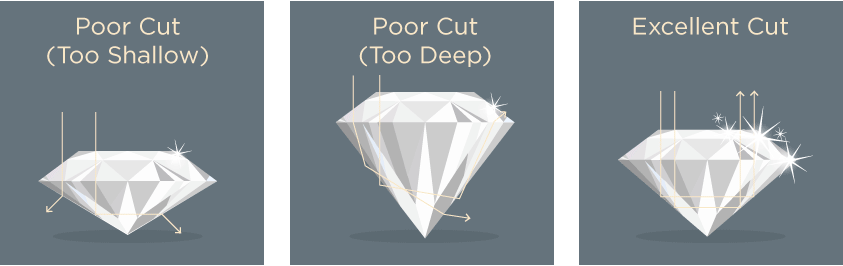
A diamond's cut is what produces the stone's brilliant sparkle. Traditionally, diamonds are cut to produce 58 tiny facets, or flat surfaces, measuring only two millimeters in diameter. The expertise of the diamond cutter greatly affects the sharpness of the cut and thus, the diamond's refraction of light. A finely cut diamond will appear very clear and fiery while poorly cut stones will seem dull and lifeless in comparison.
How is Diamond Cut Graded?
When a diamond is properly cut, light refracts from the top of the diamond. An improperly cut diamond loses light and that sparkle that you want. A diamond cut has three basic characteristics: brightness, fire, and scintillation. Brightness refers to the total amount of light that is reflected from the diamond. Fire indicates the dispersion of light into the color spectrum. Scintillation is a measure of diamond sparkle or how light flashes with movement. Unfortunately, none of these attributes can be measured objectively, making grading difficult.
In early 2005, the GIA unveiled a diamond cut grading system for standard round diamonds in the D-to-Z color range. The point was to create a way to rate diamond cut on a five-tiered scale ranging from Excellent to Poor. This rating scale is dynamic, meaning that changes are still being made. Diamonds with a cut rating of Excellent are of the highest quality and reflect nearly all light that enters the diamond. Lower ratings include Very Good, representing high-quality cut diamonds; Good which while not quite as nice as the top rating diamonds, still allows light to pass through the gemstone; Fair, which is defined as a lesser gemstone that still allows some light to reflect; to finally, Poor, representing diamonds that are cut so inadequately that most light is lost through the bottom or sides of the gemstone.
Proportion, polish, and symmetry are all critical to a diamond's beauty and value. When the cut is Ideal, the diamond creates a display of light. An Ideal diamond takes twice as long to cut and polish. Our Ideal cut stones are certified by the prestigious gemological laboratory, American Gem Society Laboratory (AGS). Each Ideal Cut diamond comes with its own official AGS grading report and laser inscription identification.
Who Grades Diamonds?
Diamonds can be unofficially graded by anyone and because there is so much objectivity involved in diamond grading, it's very important to know the qualifications of the experts behind the grading. Hence, many reputable jewelers rely on the American Gem Society Laboratory (AGS), a premier and official laboratory that grades the cut of a diamond. The AGS guarantees and authenticates quality, cut, color, clarity, and carat weight of the diamond. Their Diamond Quality™ Certificate provides assurance of a quality diamond backed by a knowledgeable and ethical member of the American Gem Society while providing the consumer with a powerful and accountable diamond document.
Diamond Shape
Many people confuse cut with the shape of a diamond. The shape is the basic form of the diamond, meaning whether it's round, square, tear-shaped, etc. Cut, as explained above, is the precision cutting of the gemstone to create facets that reflect light. Round diamonds are the industry standard, but the shape is only limited by the skill and imagination of the diamond cutter. Diamonds that are not round are known as fancy cut diamonds. Popular cuts include princess, marquise, emerald (square), oval, pear, and heart-shaped diamonds. Other unusual shapes including triangles can also be found.
We are happy to help if you do not find the exact cut you are looking for on our site. Please feel free to visit a Reeds location closest to you, or contact us with the specifics of what you need, and we will do our best to help you find the perfect engagement ring for you. Our experts are always available to answer any of your questions. Don't hesitate to reach out via live chat, phone at 844-REEDS-40, or email at service@reeds.com.